
Cybersecurity teams are halfway through 2026 with a clear message from major threat reports: attackers are moving faster, using automation more often, and taking advantage of weak infrastructure before many organizations can respond.
For SMBs and mid-market companies, this matters because the old security playbook is not enough. Annual awareness training, basic antivirus, and occasional patching cannot keep pace with intrusion timelines measured in seconds. The companies that do best this year will be the ones that treat security as an operational discipline: know what they own, patch what matters first, harden identity, monitor cloud and SaaS activity, and practice response before an incident happens.
A caveat before we get into the data: several 2026 trend reports use incident data collected in 2025 and publish it as 2026 analysis. That does not make the findings less useful, but it does mean the numbers should be read as the best available signal from recent investigations rather than a complete picture of every 2026 incident.
1. AI is helping attackers move faster
AI is no longer just a boardroom topic or a future risk. It is showing up in the way attacks are executed.
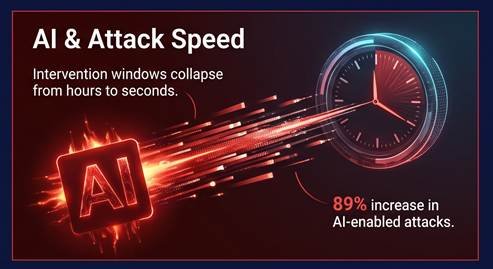
CrowdStrike’s 2026 Global Threat Report reports an 89% increase in attacks by AI-enabled adversaries and a 65% year-over-year increase in average breakout speed. Its fastest recorded eCrime breakout time was 27 seconds. Verizon’s 2026 DBIR page also notes that 15 attack techniques are being bolstered by generative AI.
That does not mean every phishing email is now written by a superintelligent attacker. The practical issue is simpler: AI helps attackers scale work that used to take time. Reconnaissance, lure writing, social engineering, credential abuse, and post-compromise activity can happen faster and with fewer obvious signs.
For SMBs, the priority is not to “buy AI security” as a slogan. The priority is to reduce the amount of time an attacker has before someone notices.
Practical steps:
- Require phishing-resistant multifactor authentication where possible, especially for admins, finance, email, VPN, cloud, and remote access.
- Review AI tool usage inside the business. Know which tools employees use and what data they are allowed to enter.
- Create basic AI governance: approved tools, access rules, logging expectations, and data handling standards.
- Monitor for unusual account behavior, not just malware signatures.
IBM’s Cost of a Data Breach Report 2025 frames part of this problem as an AI oversight gap. IBM reports that 97% of organizations with an AI-related security incident lacked proper AI access controls, and 63% lacked AI governance policies. That is a governance failure, not just a technology failure.
2. Attack speed is now a business risk
CrowdStrike’s 27-second breakout time is the kind of statistic that should change how executives think about response. Mandiant’s M-Trends 2026 report makes a similar point, describing intervention windows that have collapsed “from hours to seconds.”
That has a hard implication: if your incident response process starts with someone noticing an alert manually, forwarding it to IT, waiting for a meeting, and then deciding what to do, you may already be behind.
SMBs do not need a 50-person security operations center to improve. They do need predefined escalation paths and the ability to act quickly.
Practical steps:
- Define who can disable an account, revoke sessions, isolate a machine, or block an IP address.
- Keep contact lists current for IT, leadership, legal, cyber insurance, vendors, and outside incident response support.
- Run tabletop exercises for ransomware, business email compromise, and cloud account takeover.
- Make sure logs are retained long enough to investigate an incident. If logs disappear after a few days, responders may not be able to reconstruct what happened.
The goal is not perfection. The goal is to avoid improvising during the first hour of an attack.
3. Vulnerability exploitation is back at the center
For years, many security conversations focused heavily on stolen credentials. Credentials still matter, but software vulnerabilities are driving more breaches.
Verizon’s 2026 DBIR page reports that 31% of breaches now start with software vulnerabilities. Mandiant also calls out edge devices and network appliances being exploited before patches are available. CrowdStrike reports that 40% of vulnerabilities exploited by China-nexus adversaries targeted edge devices.
This is especially relevant for SMBs because edge devices often fall into a gap between IT, vendors, and managed service providers. Firewalls, VPN appliances, routers, remote access tools, virtualization platforms, and other internet-facing systems may not get the same patch attention as laptops and servers.
Practical steps:
- Maintain an inventory of internet-facing assets, including firewalls, VPNs, remote access tools, cloud portals, and SaaS admin panels.
- Prioritize patching based on exposure and known exploitation, not just severity scores.
- Remove or restrict legacy remote access services.
- Review vendor responsibility: who patches what, how fast, and how you verify it happened.
- Use vulnerability scanning, but pair it with ownership. A scan that nobody acts on is just a report.
Mid-market companies should also treat virtualization platforms and SaaS integrations as high-value systems. Mandiant’s 2026 reporting highlights virtualization stack targeting and SaaS integration abuse, including paths to large-scale data theft and movement across cloud environments.
4. Ransomware is becoming broader extortion
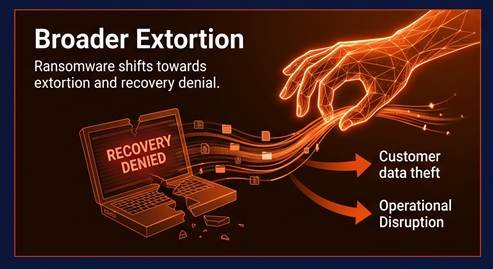
Ransomware has not gone away. Verizon reports that 48% of breaches involve ransomware. But the pattern is changing. Mandiant highlights “Recovery Denial” extortion, where attackers pressure victims beyond encryption alone.
That matters because backups, while essential, are not the whole answer. If attackers steal sensitive data, disrupt recovery systems, target identity infrastructure, or pressure customers and partners, the incident becomes a business continuity and trust problem.
Chainalysis’ 2026 Crypto Crime Report Introduction shows the financial side of this ecosystem remains active. It reports that illicit cryptocurrency addresses received at least $154 billion in 2025, a 162% year-over-year increase, while noting that illicit activity remains below 1% of attributed crypto transaction volume. It also reports that stablecoins accounted for 84% of illicit transaction volume and that DPRK-linked hackers stole $2 billion, including the Bybit exploit at nearly $1.5 billion.
For SMBs, the takeaway is not to become experts in blockchain tracing. It is to assume extortion groups have payment channels, laundering infrastructure, and playbooks that keep evolving.
Practical steps:
- Keep offline or immutable backups and test restoration regularly.
- Segment critical systems so one compromised account cannot reach everything.
- Protect backup consoles with strong authentication and separate admin accounts.
- Prepare communications templates for customers, employees, vendors, and regulators.
- Know what data is most sensitive and where it lives.
If you have never tested whether you can restore key systems under pressure, you do not have a ransomware plan. You have a backup product.
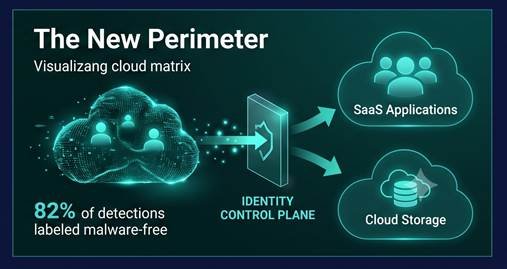
5. Cloud, SaaS, and identity are becoming the new perimeter
CrowdStrike reports a 266% increase in cloud-conscious intrusions by state-nexus threat actors. Mandiant highlights SaaS integration abuse and cross-cloud lateral movement. CrowdStrike also reports that 82% of detections in 2025 were malware-free.
That last number is important. If most detections are malware-free, then traditional malware-focused tooling will miss a lot of attacker behavior. Many intrusions now look like legitimate logins, API calls, OAuth grants, token abuse, and admin activity.
For SMBs and mid-market companies, identity is the control plane. Email, cloud storage, customer systems, finance platforms, HR tools, and developer environments often depend on the same identity provider. If attackers compromise identity, they may not need malware.
Practical steps:
- Enforce MFA for all users and stronger MFA for privileged roles.
- Audit admin accounts monthly.
- Remove stale accounts and unused SaaS applications.
- Review OAuth apps and third-party integrations.
- Monitor impossible travel, unusual token use, mass downloads, and privilege changes.
- Separate daily-use accounts from admin accounts.
IBM also recommends fortifying human and machine identities, including non-human identities. That is a practical point for growing companies. Service accounts, API keys, automation tokens, and SaaS integrations can become long-lived backdoors if nobody owns them.
6. Geopolitics is no longer separate from everyday cyber risk
The World Economic Forum’s Global Cybersecurity Outlook 2026, written with Accenture and published January 12, 2026, focuses on accelerating AI adoption, geopolitical fragmentation, widening cyber inequity, faster and more complex attacks, sovereignty challenges, and capability gaps.
That may sound like a large-enterprise or government concern, but SMBs are part of the same supply chains. A regional manufacturer, software provider, healthcare group, construction firm, or professional services company can become a target because of who they serve, what data they hold, or which systems they connect to.
ENISA’s Threat Landscape 2025, revised in January 2026, analyzed 4,875 incidents from July 1, 2024 to June 30, 2025. Its focus on threats facing EU authorities and private-sector organizations reinforces the same point: cyber risk sits inside a wider economic and political environment.
For business leaders, this means vendor risk and operational resilience matter. If a key SaaS provider, logistics partner, managed service provider, or payment vendor goes down, your business may feel the impact even if your own systems are untouched.
Practical steps:
- Identify critical vendors and ask how they handle incidents.
- Review contracts for notification timelines and security responsibilities.
- Keep contingency plans for core business functions.
- Do not assume cyber insurance replaces operational readiness.
- Map which systems support revenue, payroll, customer delivery, and compliance.
What SMBs should prioritize for the rest of 2026
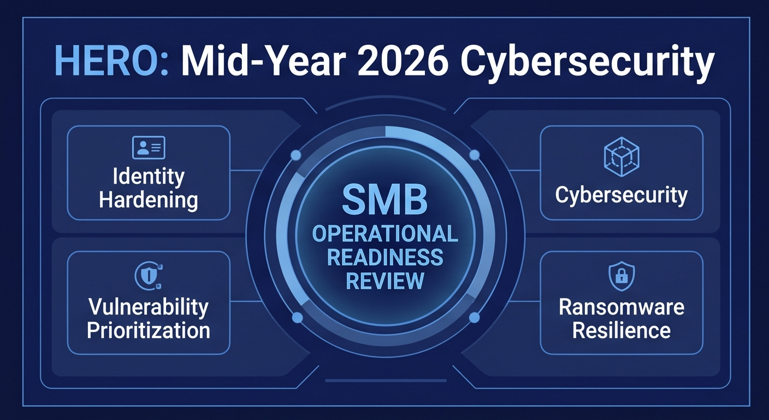
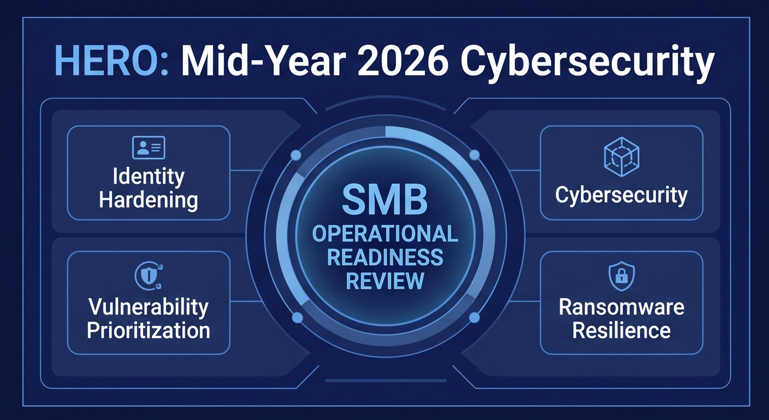
The mid-year 2026 cybersecurity trends point toward one conclusion: security teams need to move from general awareness to operational readiness.
- Build an accurate asset inventory
Start with internet-facing systems, cloud accounts, SaaS platforms, admin accounts, and critical data stores. - 2.Harden identity
Turn on MFA everywhere, prioritize phishing-resistant MFA for high-risk users, remove stale accounts, and separate admin access from daily work. - 3. Patch based on real exposure
Prioritize exploited vulnerabilities, edge devices, VPNs, firewalls, virtualization platforms, and externally accessible systems. - 4. Improve detection and logging
Make sure you can investigate identity, endpoint, cloud, and SaaS activity. Retain logs long enough to matter. - 5. Test ransomware recovery
Validate backups, restoration steps, privileged access, and communications plans. - 6. Govern AI use
Create simple rules for approved tools, sensitive data, access controls, and monitoring. - 7. Practice response
Run tabletop exercises. Decide who acts, who approves, who communicates, and who calls outside help.
Sources
- Verizon, 2026 Data Breach Investigations Report: https://www.verizon.com/business/resources/reports/dbir/
- CrowdStrike, 2026 Global Threat Report: https://www.crowdstrike.com/en-us/global-threat-report/
- Google Cloud / Mandiant, M-Trends 2026 Report: https://cloud.google.com/security/resources/m-trends
- World Economic Forum, Global Cybersecurity Outlook 2026: https://www.weforum.org/publications/global-cybersecurity-outlook-2026/
- IBM, Cost of a Data Breach Report 2025: https://www.ibm.com/reports/data-breach
- ENISA, Threat Landscape 2025: https://www.enisa.europa.eu/publications/enisa-threat-landscape-2025
- Chainalysis, 2026 Crypto Crime Report Introduction: https://www.chainalysis.com/blog/2026-crypto-crime-report-introduction/
Ready to take action?
Prometheus Cybersecurity helps SMB and mid-market teams turn security priorities into practical action. If you want to understand where your organization stands against the mid-year 2026 cybersecurity trends, schedule a cybersecurity readiness review with Prometheus. We will help you assess identity risk, cloud and SaaS exposure, patch priorities, ransomware resilience, and incident response gaps before attackers test them for you.