
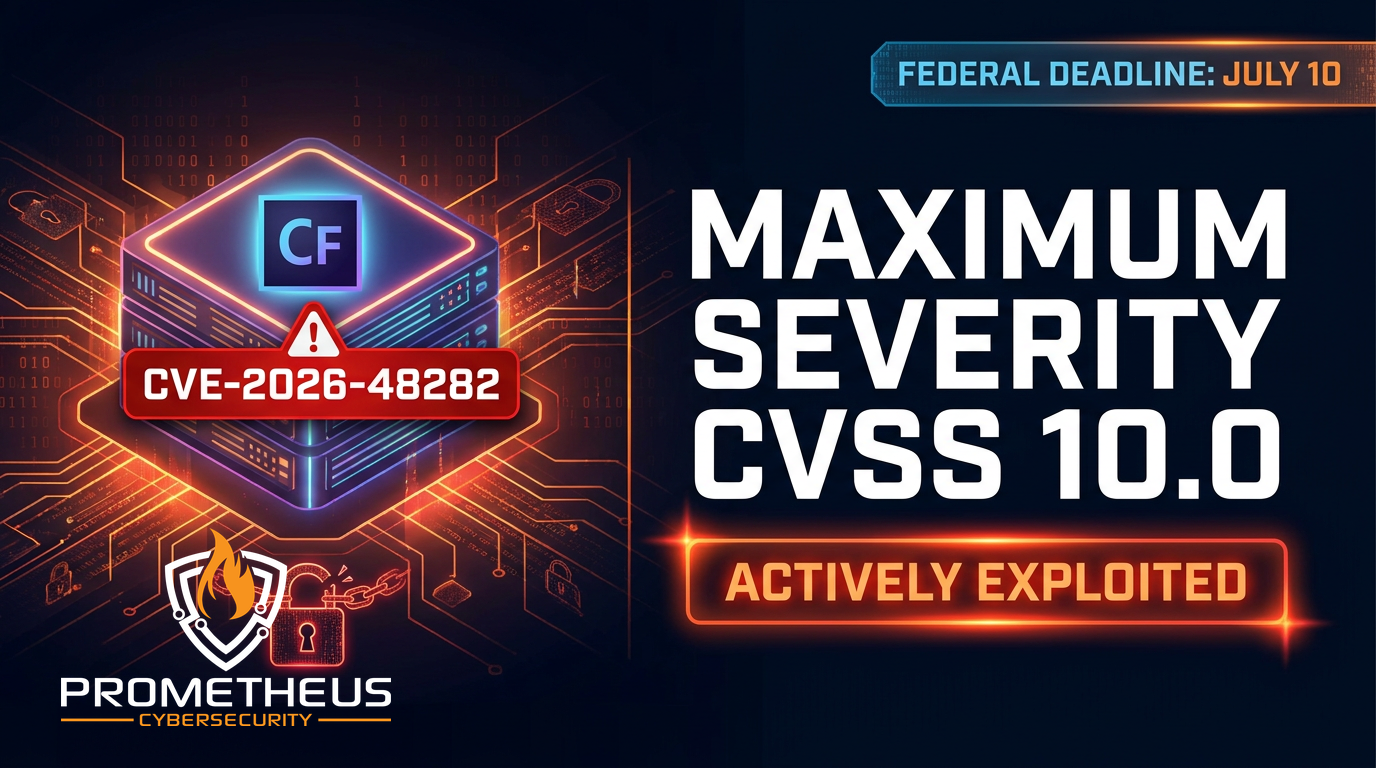
URGENT SECURITY ALERT | Published July 9, 2026
A maximum-severity Adobe ColdFusion vulnerability is being actively exploited in the wild, prompting federal cybersecurity authorities to issue an emergency 72-hour patching mandate. Security teams managing ColdFusion deployments must take immediate action to prevent potential compromise.
CVE-2026-48282: What You Need to Know
The Cybersecurity and Infrastructure Security Agency (CISA) added CVE-2026-48282 to its Known Exploited Vulnerabilities catalog on July 7, 2026, following Adobe’s disclosure that the flaw is being exploited in limited but targeted attacks. With a CVSS score of 10.0—the maximum possible severity rating—this Adobe ColdFusion vulnerability represents a critical threat to enterprise infrastructure.
CVE-2026-48282 is a path traversal vulnerability (CWE-22) that allows unauthenticated remote attackers to execute arbitrary code on vulnerable ColdFusion servers. The flaw requires no authentication, no user interaction, and minimal technical complexity to exploit, making it an ideal target for threat actors seeking rapid system compromise.
Why This Adobe ColdFusion Vulnerability Scores 10.0

The CVSS vector (CVSS:3.1/AV:N/AC:L/PR:N/UI:N/S:C/C:H/I:H/A:H) reveals why security experts consider this among the most dangerous vulnerabilities disclosed in 2026:
- Network Attack Vector (AV:N): Exploitable remotely over the internet
- Low Attack Complexity (AC:L): Simple to exploit once discovered
- No Privileges Required (PR:N): No authentication credentials needed
- No User Interaction (UI:N): Fully automated exploitation possible
- Changed Scope (S:C): Impact extends beyond the vulnerable application
- High Impact on Confidentiality, Integrity, and Availability: Complete system compromise
This combination of factors makes CVE-2026-48282 a perfect pre-authentication remote code execution vulnerability—the most dangerous class of security flaw.
Active Exploitation Confirmed
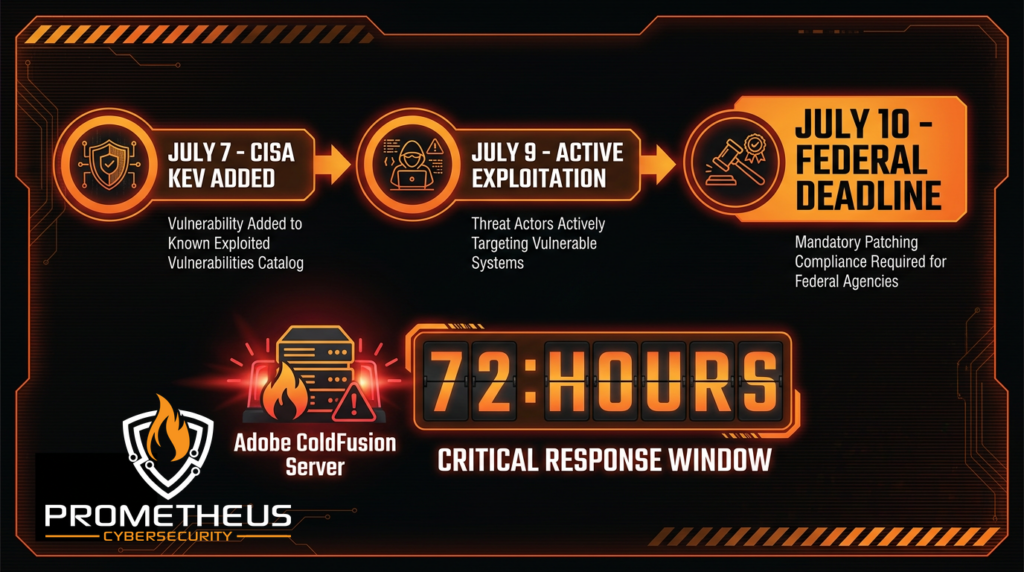
Adobe’s security bulletin APSB26-68 explicitly warns that “CVE-2026-48282 has been exploited in the wild in limited attacks targeting Adobe ColdFusion.” While initial attacks appear targeted rather than widespread, the publication of technical details and the vulnerability’s trivial exploitation complexity mean mass scanning and exploitation typically follow within days.
Federal agencies face a mandatory patching deadline of Friday, July 10, 2026—just three days after disclosure—under CISA’s Binding Operational Directive 26-04. This aggressive timeline reflects the severity of the threat and the high probability of escalating attacks.
Who Is at Risk?
Adobe ColdFusion powers web applications across high-value enterprise environments, including:
- Government agencies (federal, state, and local)
- Financial services institutions
- Healthcare organizations
- Large enterprise web applications
- Legacy systems with internet exposure
The vulnerability affects widely deployed ColdFusion versions:
- ColdFusion 2025: Update 9 (version 2025.0.0.x) and earlier
- ColdFusion 2023: Update 20 (version 2023.0.0.x) and earlier
- ColdFusion 2021: Earlier versions also affected
If your organization runs internet-facing ColdFusion servers, assume you are being actively scanned by threat actors.
Technical Impact: From Path Traversal to Complete Compromise
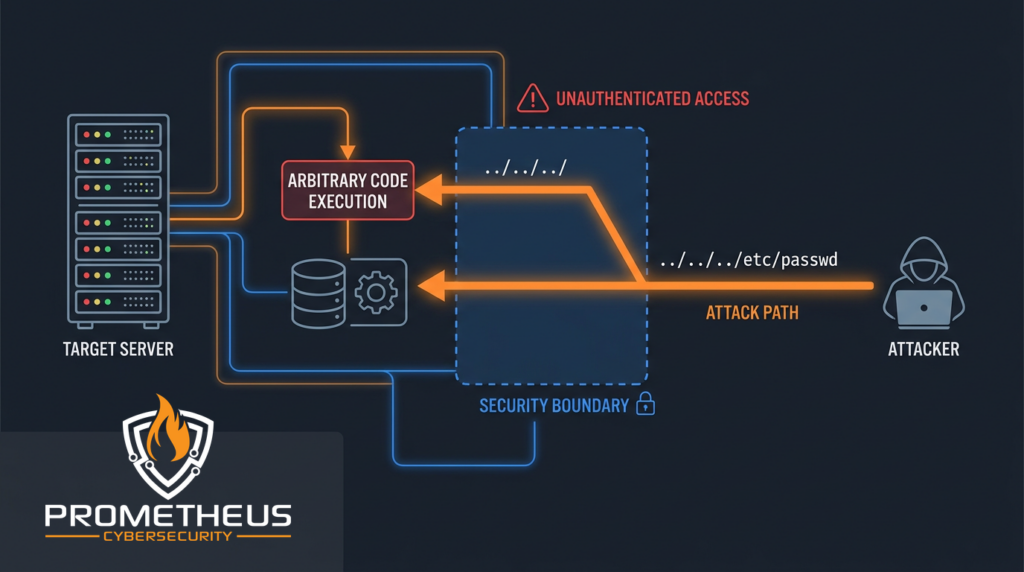
Path traversal vulnerabilities allow attackers to access files and directories outside the intended application scope by manipulating file path references. In CVE-2026-48282, Adobe ColdFusion’s improper validation of pathname restrictions enables attackers to traverse the directory structure and execute arbitrary code in the context of the ColdFusion process.
The “changed scope” designation in the CVSS scoring indicates that successful exploitation doesn’t just compromise the ColdFusion application—it impacts other resources on the host system. Combined with the arbitrary code execution capability, attackers achieve:
- Full server compromise: Execute malicious code with application privileges
- Data exfiltration: Access sensitive files and databases
- Lateral movement: Use compromised ColdFusion servers as pivot points
- Persistence: Install backdoors for long-term access
- Service disruption: Modify or destroy critical application data
For organizations managing sensitive data or critical infrastructure, the risk of complete compromise demands immediate action.
Immediate Action Required: Patch Now
Adobe released patches for CVE-2026-48282 in security bulletin APSB26-68 on July 7, 2026, with Priority 1 designation—Adobe’s highest urgency rating reserved for actively exploited critical vulnerabilities.
Patched Versions
Security teams must immediately update to these versions or later:
- ColdFusion 2025: Version 2025.0.0.331385 and above
- ColdFusion 2023: Version 2023.0.0.330468 and above
- ColdFusion 2021: Version 2021.0.0.323925 and above
Patching Process
- Verify your ColdFusion version immediately—check deployment inventory for all instances
- Download patches from Adobe’s security bulletin (APSB26-68)
- Test patches in a staging environment if possible, but don’t delay production deployment
- Apply updates to all internet-facing ColdFusion servers first, then internal systems
- Verify successful patching by confirming new version numbers post-update
- Review system logs for indicators of compromise dating back to early July
If Immediate Patching Is Impossible
For organizations unable to patch within the 72-hour window:
- Disconnect vulnerable ColdFusion servers from the internet immediately
- Implement network-level access controls restricting ColdFusion access to trusted networks only
- Activate enhanced monitoring for suspicious activity
- Consider temporarily discontinuing use of unpatched instances per CISA guidance
- Conduct forensic triage following CISA’s incident response procedures
Multiple Critical Flaws in APSB26-68
CVE-2026-48282 is not the only maximum-severity flaw in Adobe’s July security bulletin. APSB26-68 addresses multiple critical vulnerabilities, including:
- CVE-2026-48316: Arbitrary code execution (CVSS 10.0)
- CVE-2026-48283: Unrestricted file upload leading to arbitrary code execution (CVSS 10.0)
This cluster of critical vulnerabilities underscores the urgency of updating Adobe ColdFusion deployments across the board, not just for CVE-2026-48282.
Federal Compliance and BOD 26-04
Federal agencies must comply with CISA’s Binding Operational Directive 26-04, “Prioritizing Security Updates Based on Risk,” which mandates patching of Known Exploited Vulnerabilities within strict timeframes. The July 10 deadline for CVE-2026-48282 is non-negotiable for government systems.
Private sector organizations should treat CISA’s KEV catalog additions as authoritative threat intelligence—if federal agencies are required to patch within 72 hours, commercial entities face the same risk landscape and should adopt similar urgency.
Verify and Harden
After patching, security teams should:
- Review Adobe’s ColdFusion Lockdown Guides for hardening recommendations
- Update Java/JDK to current LTS versions as recommended by Adobe
- Conduct vulnerability scanning to confirm patch deployment
- Review authentication and access controls for ColdFusion admin interfaces
- Implement monitoring for ColdFusion-specific attack patterns
- Assess internet exposure of all ColdFusion deployments and minimize attack surface
The Bottom Line
CVE-2026-48282 represents a clear and present danger to organizations running Adobe ColdFusion. With a perfect 10.0 CVSS score, confirmed active exploitation, no authentication requirements, and trivial attack complexity, this vulnerability combines every factor that makes security professionals lose sleep.
The federal government’s 72-hour patching mandate is not bureaucratic caution—it reflects the severity of the threat and the likelihood of accelerating attacks. Security teams managing ColdFusion infrastructure must treat this as a drop-everything emergency.
Don’t wait for Friday’s deadline. Patch now.
Resources
- Adobe Security Bulletin APSB26-68: https://helpx.adobe.com/security/products/coldfusion/apsb26-68.html
- CISA Known Exploited Vulnerabilities Catalog: https://www.cisa.gov/known-exploited-vulnerabilities-catalog
- NVD CVE-2026-48282 Details: https://nvd.nist.gov/vuln/detail/CVE-2026-48282
- CISA BOD 26-04: https://www.cisa.gov/news-events/directives/bod-26-04-prioritizing-security-updates-based-risk
About Prometheus Cybersecurity: We provide expert penetration testing, vulnerability assessments, and cybersecurity advisory services to help organizations stay ahead of emerging threats. Contact us for comprehensive security assessments and incident response planning.